
Benefits of Aquatic Therapy
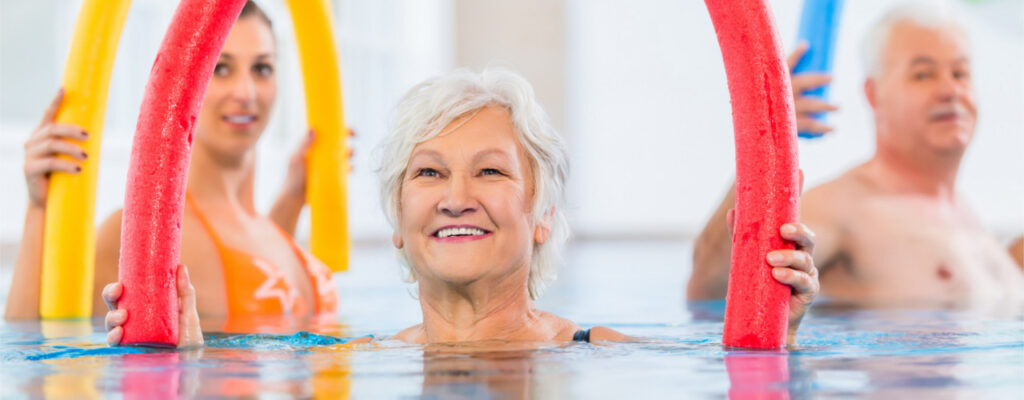
A popular summertime activity to beat the heat and relax often involves a swimming pool. Pools can be utilized year-round to help meet your fitness goals, combat any pain, and help to prevent injuries. Sure, you can swim laps (which is great!), but there are infinite ways to complete exercises in the pool as well.
First, let’s talk about the reasons you may choose aquatic therapy over land therapy. Aquatic therapy helps offload the joints through buoyancy and hydrostatic pressure (more on this later). This is particularly helpful if you have hip or knee osteoarthritis by taking the pressure off the joints and allowing movement without pain.
What is osteoarthritis anyway? Osteoarthritis, aka OA, is the degenerative breakdown of the cartilage that covers the ends of the bones. That cartilage provides shock-absorbing forces with movement. This lack of or breakdown of cartilage leads to changes in your bone structure and can cause pain, swelling, decreased range of motion, and difficulty with functional movements such as walking, squatting, or running. More than 25-30 million Americans are affected by OA.
Risk factors for OA include:
- Age (especially over 50 but increases as you get older)
- Gender (women are at a higher risk than men)
- Overuse/prior injuries (ever hear someone say an old football injury 20 years ago has come back to haunt them?)
- Obesity (more weight = more stress= more breakdown and potential injury.
So, how is someone going to exercise if they can’t even tolerate walking?? Cue aquatic therapy. When someone is in just waist-deep water, about 50% of their body weight is supported. Even more, weight is supported the deeper they get in the water. This is known as buoyancy. Buoyancy counteracts the effects of gravity by applying an upward force to gravity’s downward force. This helps unload your joints when in the pool, thus, able to decrease your pain and improve function.
Not comfortable with swimming? No worries! Having half of your body weight supported, while also feeling secure only waist deep, will help your joints and exercise tolerance tremendously! You can also wear a water belt or use pool noodles to help feel more comfortable.
Another important factor in water therapy is hydrostatic pressure…the pressure of a non-moving fluid/water in relation to gravity. So, the deeper you are, the more pressure due to more water and gravity pushing down. That’s the pressure you feel when you dive deep in the water. This pressure has many positive side effects. One is, it acts like a compression sock which improves circulation. When circulation is improved, that helps the heart work more efficiently as well. In addition, the pressure adds resistance (think walking or running in the water) which helps you strengthen your muscles and improve your endurance through the added challenge of the water pressure.
The water temperature of the pool also makes a big difference. Warmer water is typically better due to the relaxation of muscles, improved range of motion, increased blood flow and decreases pain. So, a heated-up outdoor pool from the sun is perfect!
Now that we know the benefits of aquatic therapy, where does someone even begin?! Basically, any exercise that can be completed on land, can be, at least modified, to complete in water. Walking in the pool is a great place to start! You can progress by increasing your walking speed, decreasing the depth of water, and adding more resistance through the water jets or floats. You can complete standing leg lifts, wall push-ups, trunk rotations, or even distraction by floating in the deep end.
By Dr. Laura Wolters, PT, DPT